
HumanTech Summit 2026 Program – 3–5 December, Warsaw
Registration of participants
HumanTech Workshops
Own Your Prompt: Learn to Stay the Author of Your AI-Assisted Work
 Paweł WolskiAcademy of Art in SzczecinRegister (opens in a new tab)
More
Who owns what you create with generative AI? And how can you prove that your ideas, decisions, and creative contributions are truly yours?
In this interactive workshop, participants will explore real-world copyright cases from Europe, the United States, and China, revealing how AI is making human authorship increasingly uncertain.
Through hands-on exercises, participants will learn how to:
- Establish and strengthen their claim to authorship of AI-assisted work.
- Distinguish between prompting, creative control, and legal authorship.
- Document their prompting process to provide evidence of their intellectual contributions.
How to Conquer Digital Transformation Resistance, Reduce Team Stress, and Unlock Process Innovation
 Piotr ZawistowskiSWPS UniversityRegister (opens in a new tab)
More
Join Piotr Zawistowski, PhD, at the HumanTech Summit 2026 to cut through AI hype and fear of change, and master practical workplace automation.
- Cut Through the Hype: Learn when to choose deterministic workflows and traditional algorithms over AI to achieve real ROI.
- Understand Change Management: Explore a media newsroom case study on automating viewer tips, focusing on overcoming employee fears and securing buy-in.
- Build Practical Skills: Participate in hands-on workshops using low-code and no-code tools to automate your daily tasks.
One Camera, Three Realities: Design Your Own B2B Networking Experience in VR
 Michał DziwnielFOBOS,
 Anna TemczukFOBOSRegister (opens in a new tab)
More
Why can approaching a stranger at a business conference feel stressful? How do we respond to enthusiasm, indifference or scepticism from others? And can virtual reality help us prepare for challenging professional interactions before experiencing them in real life?
In this hands-on workshop, participants will explore the psychological mechanisms of social evaluation, anxiety and the sense of presence in immersive environments.
Working in three teams, participants will become designers, scriptwriters and actors, collaboratively creating and recording three versions of the same B2B networking scenario using a single 360° camera.
Each team will explore a different social dynamic: welcoming, neutral or challenging. Participants will design conversations, direct actors and determine how verbal and non-verbal cues influence the emotional experience of a virtual interaction.
Using Fobos as a practical example, the workshop will introduce the principles of VR-based exposure, human-centered immersive design and the ethical considerations involved in creating emotionally engaging virtual environments.
By combining psychology, user experience design and hands-on immersive content production, the workshop will demonstrate how VR scenarios can be developed for communication skills training and preparation for challenging professional situations.
Participants will leave with three collaboratively produced 360° video prototypes and practical experience in designing psychologically informed immersive experiences.
Startup Pitch Deck Session
 (opens in a new tab)Patrons:
 Natalia BielczykOntology of Value
 Piotr SenkusJury:
 Ariadna GołębickaHumanTech Center, SWPS University
 Łukasz SzternPolish Development Fund (PFR)
 Kamil Szymański60 Million Congress
 Kacper WikiełFabryka AI
 Michał WłodarczykVenture Café Warsaw
 Kamil WyszkowskiUN Global Compact Network Poland
 Piotr ZientaraXfaangMentors:
 Hubert AdamczykPolish Agency for Enterprise Development (PARP)Jan Gołębiowski
 Wioletta Odalska-SobczakWarsaw Rising MuseumPiotr Senkus
Five-minute pitches on stage in front of an investor jury, held under licence from Hyper Pitch Night. Winners are announced at the official opening.
Prizes: AI tokens for the winners, funded by the Poznań Supercomputing and Networking Center (PCSS), and VOSU.AI (opens in a new tab) credits for creating with generative AI.
Jury: Ariadna Gołębicka (HumanTech Center, SWPS University), Łukasz Sztern (PFR, Polish Development Fund), Kamil Szymański (60 Million Congress), Kacper Wikieł (Fabryka AI), Michał Włodarczyk (Venture Café Warsaw), Kamil Wyszkowski (UN Global Compact Network Poland), Piotr Zientara (Xfaang)
Patrons: Natalia Bielczyk (Ontology of Value (opens in a new tab)), Piotr Senkus (senkus.info (opens in a new tab))
Mentors of the top teams: Hubert Adamczyk (PARP), Jan Gołębiowski, Wioletta Odalska-Sobczak, Piotr Senkus
Lunch Break (on your own, not provided by the organizer)
Official Opening of the Conference
 Konrad MajSWPS University, Kamil WyszkowskiUN Global Compact Network Poland
More
Announcement of Winners and Awards Startup Session.
Global AI Governance: Golden Era of Science or End of Science?
 Piotr SankowskiUniversity of Warsaw / IDEAS Research Institute
More
Artificial intelligence could usher in a golden era of discovery - or erode the foundations of open, reproducible inquiry through black-box methods, concentrated compute, and fragmented regulation. Drawing on his work in the Independent International Scientific Panel on AI, Prof. Piotr Sankowski examines how international governance will decide which future prevails, and what global rules are needed to ensure AI accelerates our work rather than replacing it.
Launch of the “Standard for Responsible AI Implementation” report – UN Global Compact Network Poland
Ta część agendy będzie prowadzona w języku polskim.
This part of the programme is held in Polish, with English captions.
UN Global Compact Network Poland zaprasza na premierę raportu „Standard Odpowiedzialnego Wdrażania AI”. Publikacja przedstawia praktyczne rozwiązania wspierające organizacje w odpowiedzialnym wdrażaniu sztucznej inteligencji, w szczególności w obszarach: AI governance, AI Act, zarządzanie ryzykiem i poszanowanie praw człowieka.
UN Global Compact Network Poland invites you to the launch of the “Standard for Responsible AI Implementation” report. The publication presents practical solutions that help organisations implement artificial intelligence responsibly, in particular in AI governance, the AI Act, risk management and respect for human rights.
Coffee Break
Preserving Human Agency in the Age of Automated Decision-Making
Moderator:  Agata CupriakPolish Information Processing Society (PTI); Panelists:
 Gabriela BarGabriela Bar Law & AI,
 Wojciech BednarukPwC,
 Włodzimierz DąbrowskiWarsaw University of Technology,
 Iwona Dzudzewicz
Networking
Official opening of the conference
Representative of the PFR Management Board, Konrad MajSWPS University, Kamil WyszkowskiUN Global Compact Network Poland
The Harms of Anthropomorphising: How Discourse Concerning AI Partners and Collaboration Does Damage
 Joanna BrysonHertie School, Germany
More
For over a century, popular science fiction and philosophical thought experiments concerning AI (and zombie) others have run in parallel to our ever-increasing capacity to understand and automate computational tasks. For fiction and philosophy, AI was a way to examine the human condition, for science and commerce, it was a way to increase productivity. Since the mid 20C the harms as well as benefits of data manipulation and long-range communication have become evident, and also become regulated. Only recently though have massively underregulated actors begun exploiting the confusion produced by fiction and philosophy in ways that further destabilise our capacity to regulate, to keep our planet safe and stable. In this talk I offer a new take on ethics that could explain the harms we are seeing, and suggest new programmes for the humanities to address our new era.
AI Governance, Law and Digital Sovereignty
Open Source Software and Digital Sovereignty in Poland
 Łukasz CeglińskiCentrum Cyfrowe Foundation,
 Kuba PiwowarCentrum Cyfrowe Foundation
TBC
AI Literacy Without Teeth, Fundamental Rights without a Forum: The Scope of Article 4 of the EU AI Act in the Medical Devices Sector
Regulating deepfakes. When law meets the challenges of synthetic media


Coffee Break
AI as a Social and Moral Partner
Between Loneliness and Innovation – People and the Economy in the Age of AI
 Zofia DzikHumanites Institute,
 Władysław JaniakHumanites Institute
When AI Seems to Think and Feel: How Mind Perception Shapes Acceptance and Support for Regulation
 Tomasz GrzegorczykPoznan University of Economics and Business,
 Konrad HryniewiczGdynia Maritime University,
 Paweł NiszczotaPoznan University of Economics and Business
Robots and Moral Decision-Making
Designing Embodied AI for Well-Being with the Neffy Robot

Building from and building towards human reasoning capabilities
 Sangeet KhemlaniUS Naval Research Laboratory, USA
More
Contemporary approaches to AI often treat reasoning as a static output -- they evaluate an agent purely by whether a final conclusion matches what a competency human might produce. Finer-grained analyses of the traces of reasoning behavior in AI systems reveals stark divergences from human reasoning processes. This talk highlights both advances and limitations of recent AI systems, and it describes computational cognitive modeling work that simulates the actual underlying mental processes humans use when they reason in various domains. It shows how the model can simulate both verbal and non-verbal reasoning behavior, and argues in favor of cognitive modeling as a way to illuminate human thinking abilities, both the strengths and frailties of how people reason. It further shows how cognitive modeling can help design next-generation AI and human-machine teaming systems that reason more transparently and compatibly in real-world contexts.
Lunch Break
Identity, Intimacy and Influence in Human–AI Interaction
Narcissistic Doppelgänger, Empathetic Companion, Immature Assistant: Mapping IT Professionals' Modalities of Relating to Artificial Intelligence
 Małgorzata OsowskaEducational Research Institute – National Research Institute
The Cybernetic Erogenous Zone: Desire, Distance, and the Future of Co-Constructed Intimacy in Digital Communication
The Impact of AI Response Latency on Consumer Decision-Making: Insights from Series of Methodological Experiments
 Joanna DixaSWPS University in Wrocław,
 Agata SobkówSWPS University in Wrocław,
 Łukasz SumlińskiSWPS University in Wrocław
Between Enthusiasm and Distrust: Points of Tension and Ambivalence in Human–AI Communication


Coffee Break
Who Is Responsible? Distributed Accountability in AI and Software Teams
Moderator:  Łukasz KarwackiSpeakviser; Panelists:
 Jan BlewWroclaw Business Academy, Joanna BrysonHertie School, Germany,
 Natalia ĆwikIDEA Natalia Ćwik,
 Piotr HołowniaE. Wedel,
 Michalina SzpyrkaPolish Academy of Sciences
Coffee Break
AI Literacy, Learning and Epistemic Agency
Measuring Teachers’ AI Literacy in Poland: Adaptation and Validation of the Artificial Intelligence Literacy Scale for Teachers (AILST)
Cultivating Ethical AI Literacy in Engineering: A Problem-Based Learning Framework for Responsible Technology Use
Teaching When Not to Use AI: Educators as Guardians of Epistemic Agency in AI-Mediated Education
 Eric KotaConnect Brussels,
 Symeon NikolidakisUniversity of Limassol


End of day 1
Get Together Party
Not included in conference tickets. Separate ticket: 99 PLN. Buy a party ticket (opens in a new tab)
- Discussion Panel
How Does Technology Expand Art and Theatre?
Moderator:
 Martyna GrothSWPS University; Panelists:
 Natalia KupsikPolish Development Fund (PFR),
 Filip Gabriel PudłoPolish National Film, Television and Theatre School in Łódź,
 Franciszek SobiechLodz University of Technology,
 Sylwia ŻółkiewskaPolish-Japanese Academy of Information Technology
More
“Each age finds its own technique.” – Jackson Pollock
An interdisciplinary meeting of researchers and artists will be devoted to the role of technology in expanding the fields of theatre and the visual arts, and in their hybridisation and intermediality. We will be interested in a variety of ideas and artistic practices connected with technology (e.g. Techspressionism), in which digital and interactive solutions and generative AI help shape the language of the work, as well as in new forms of work and shared authorship emerging at the intersection of the performing arts, the visual arts, engineering and science. Participants will present their research and projects and will jointly reflect on possible scenarios for the development of the relationship between the visual arts, theatre and technology in the future.
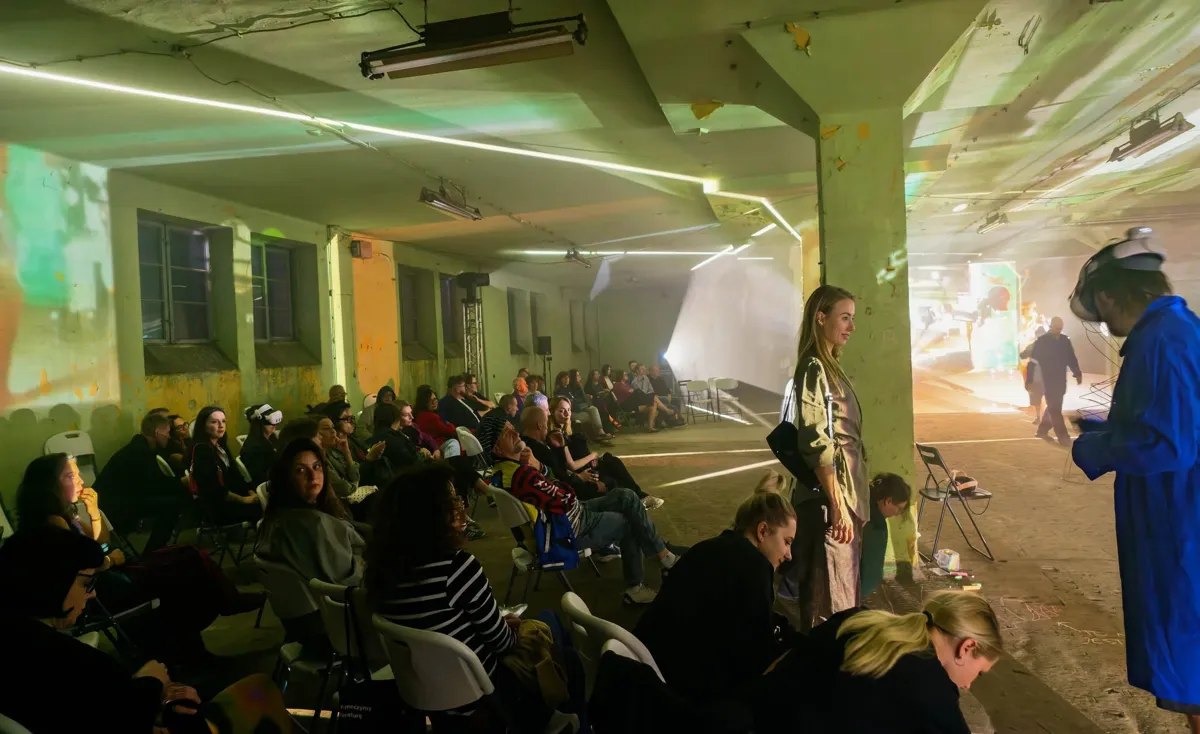
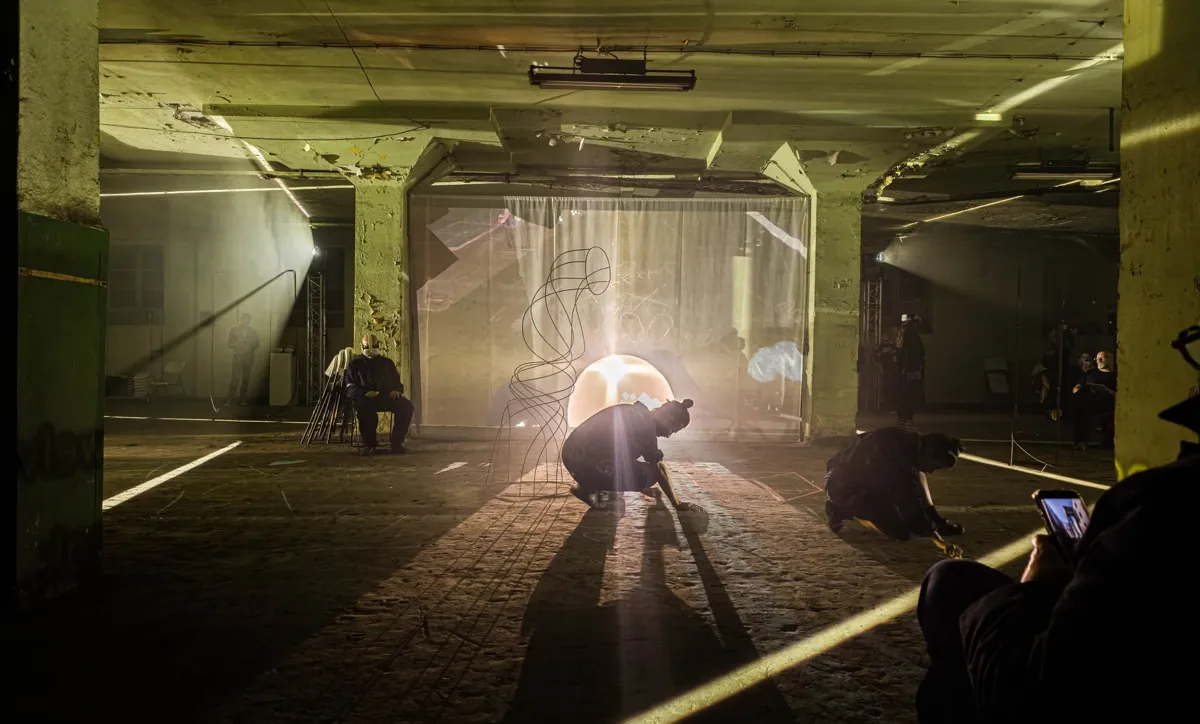
Accompanying Event / LUMO: The Tower of Babel — a hybrid performance directed by Krzysztof Garbaczewski
More
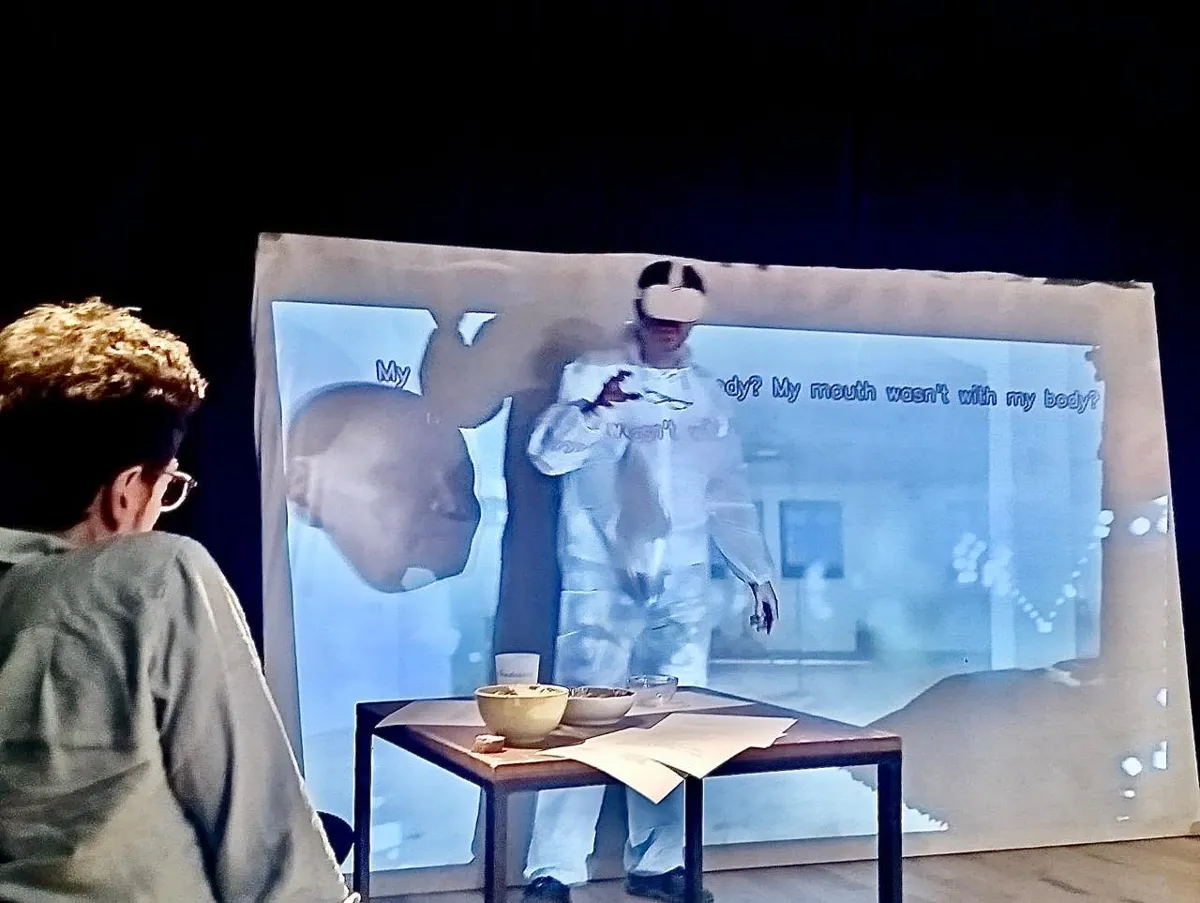
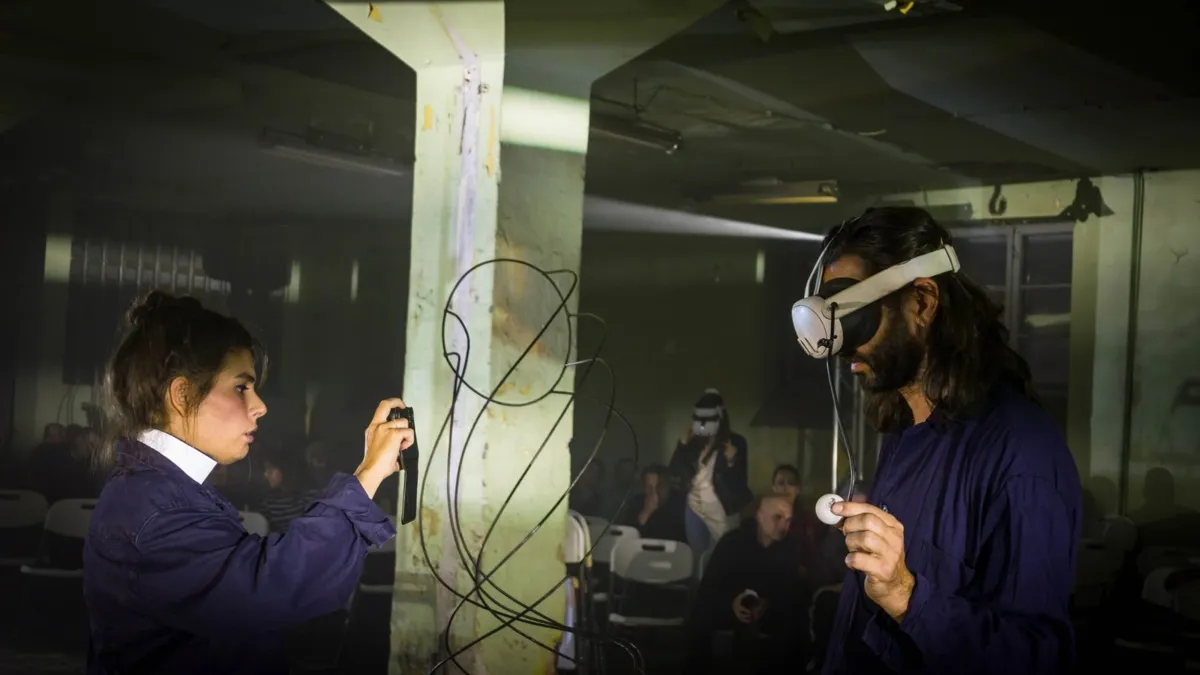
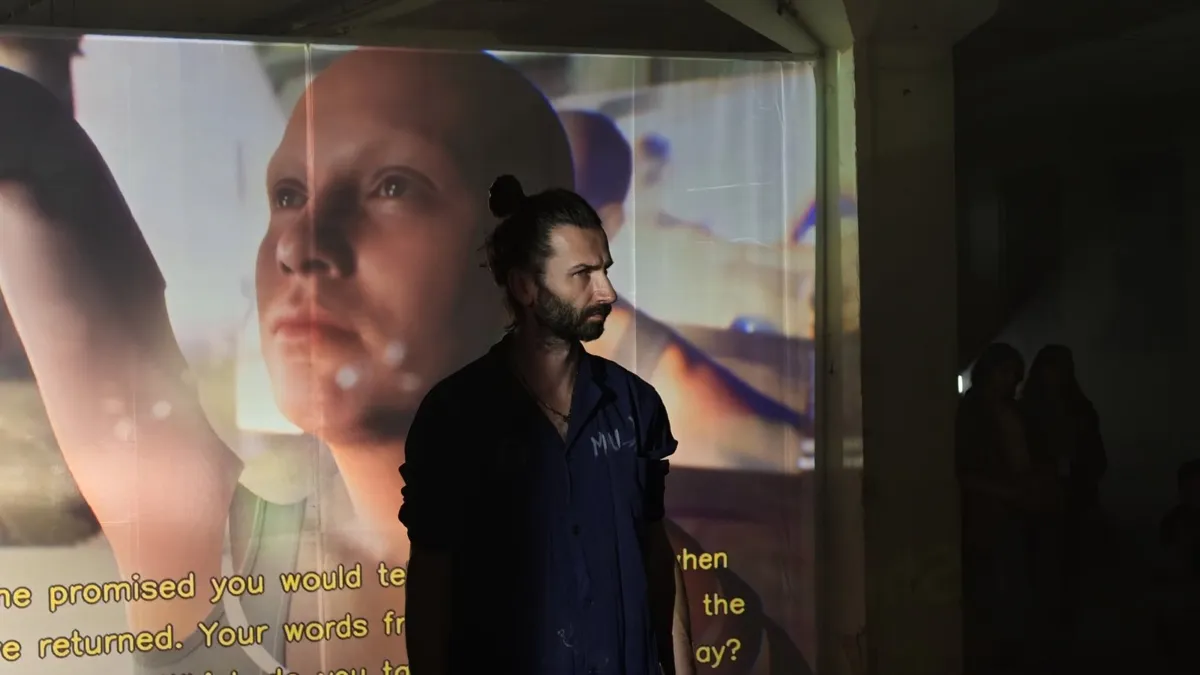
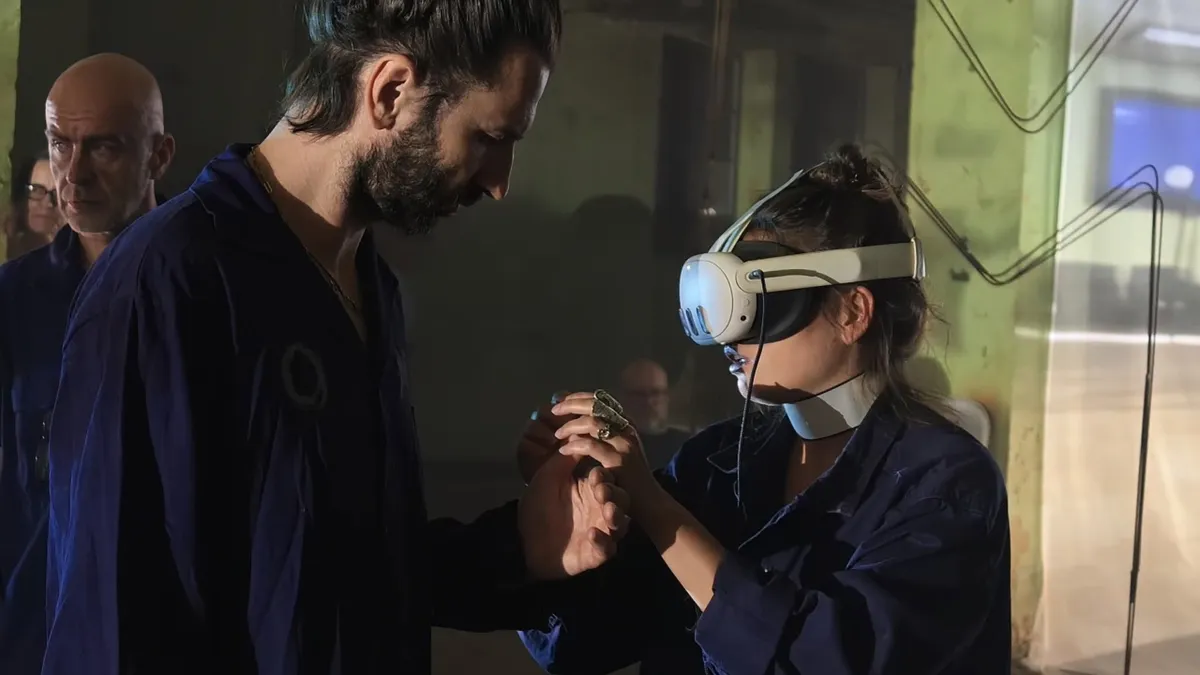
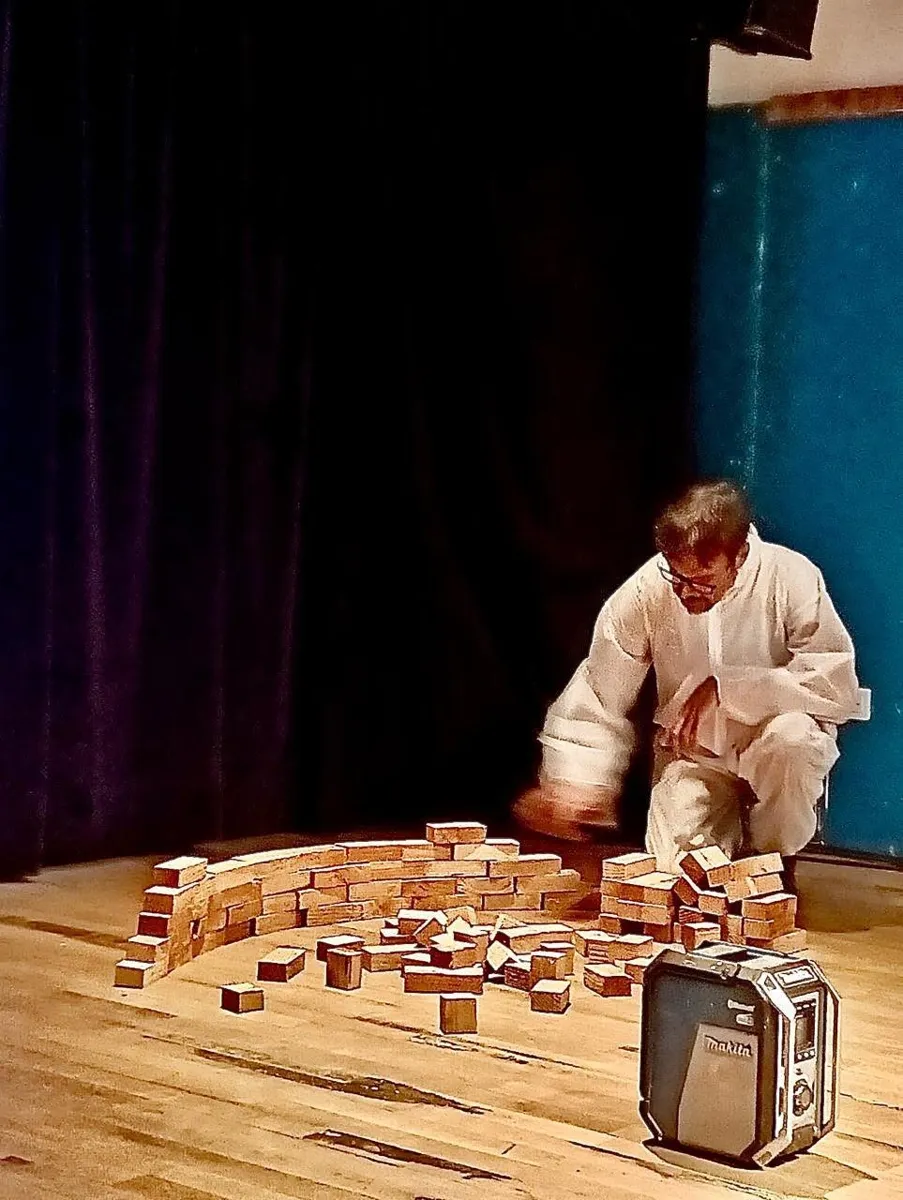
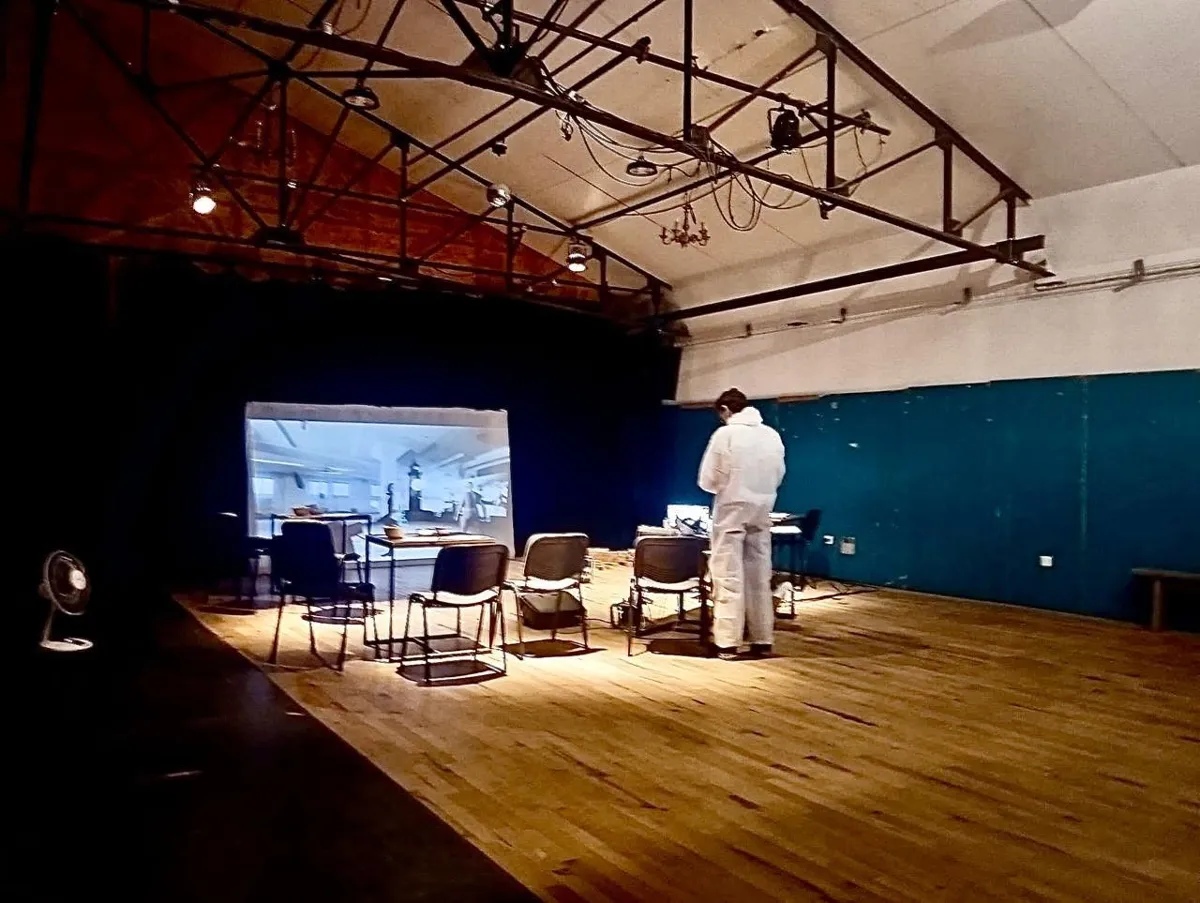
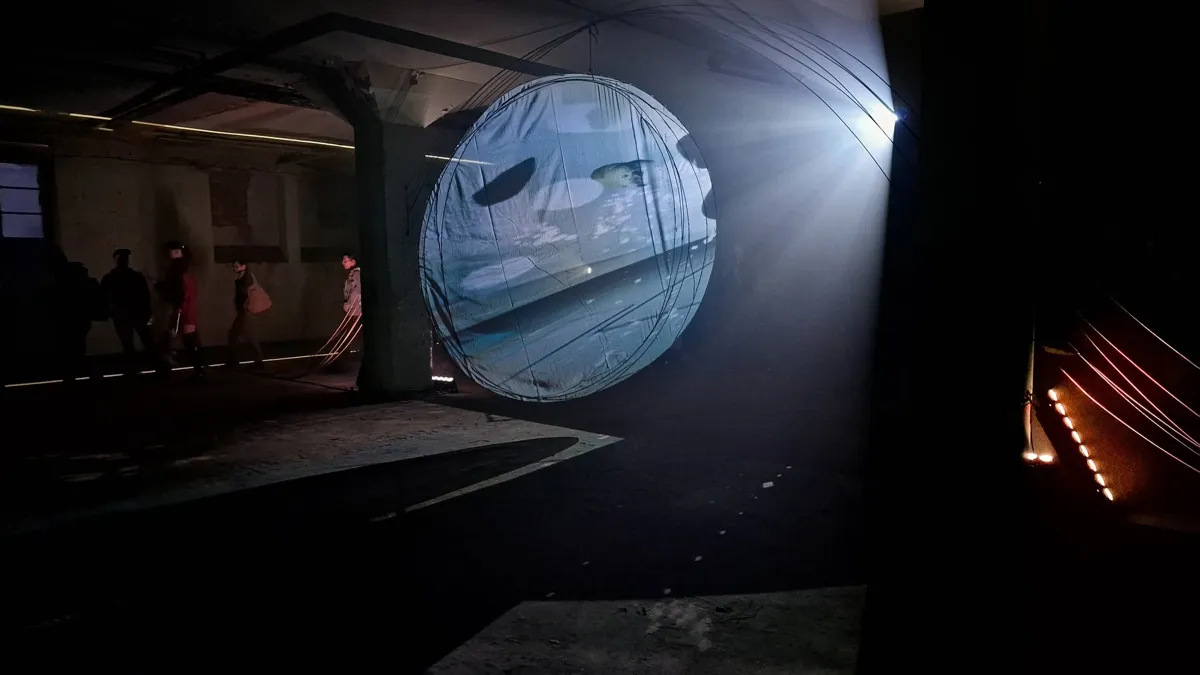
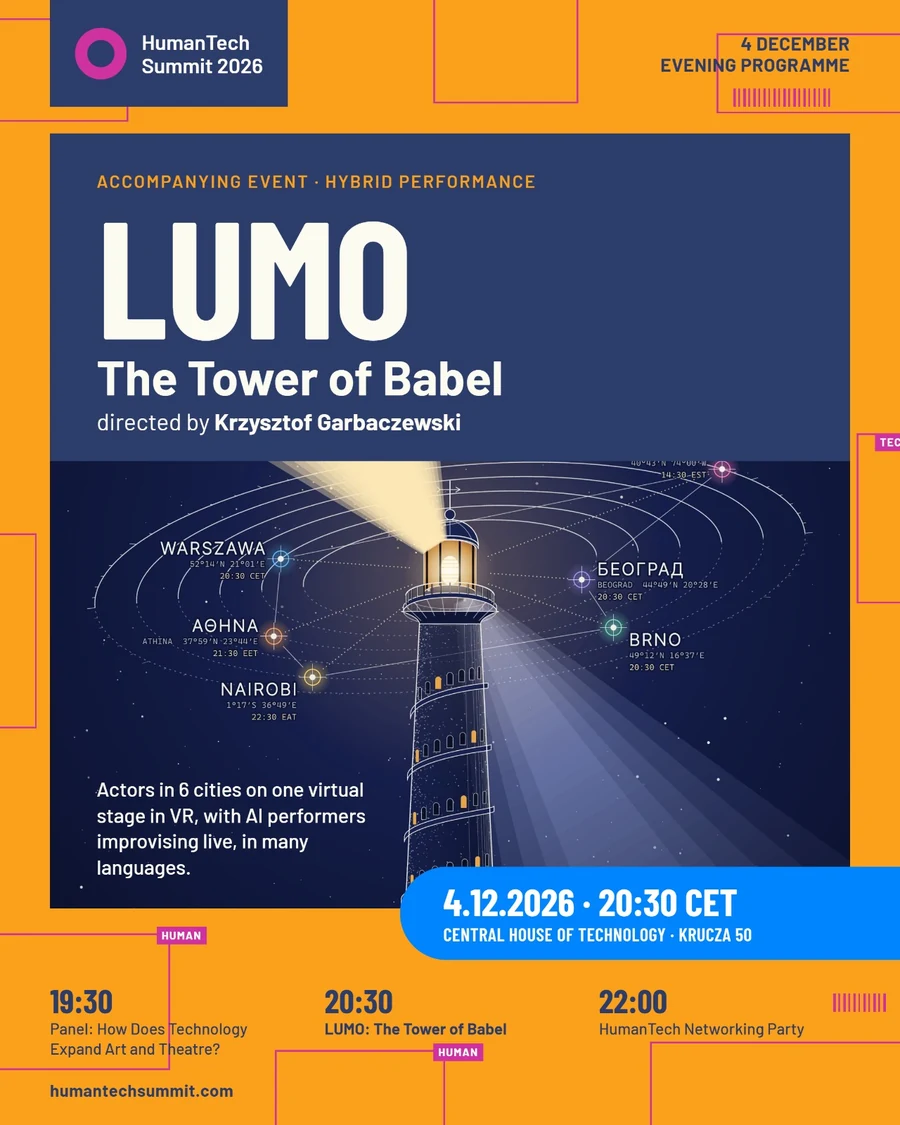
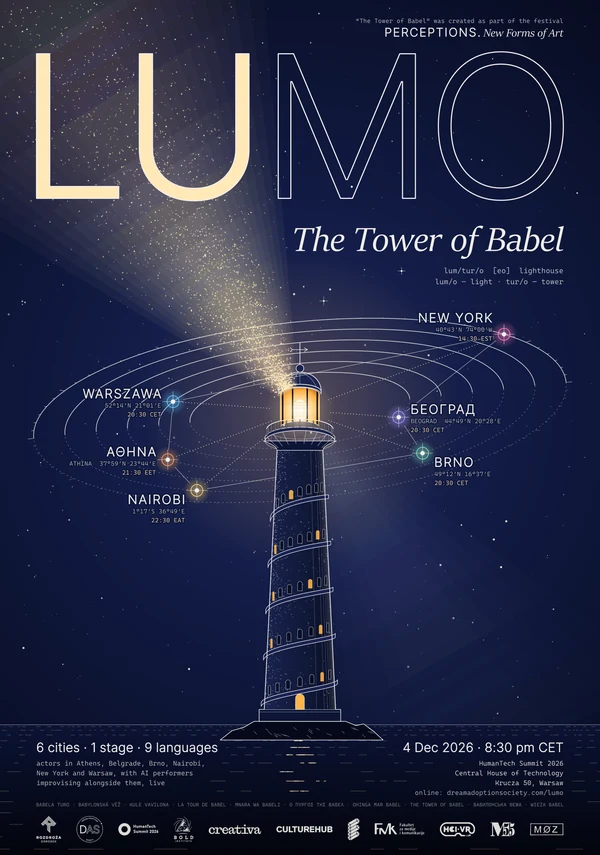
LUMO is a living online theatre: one shared virtual stage where actors in different cities play together in VR, alongside AI performers who improvise with them live, in many languages. The audience can take part in a mixed reality experience inside the VR app, watch the hybrid performance through the eye of a camera streaming onto the screens, or watch it online.
Tower of Babel, inspired by Ludwik Zamenhof and Esperanto, premiered in September 2026 at the PERCEPCJE festival in Lublin. It asks how we can understand each other in a world divided by language, conflict and technology. Every show is improvised anew from what the system remembers of the previous ones. On 4 December it will be performed simultaneously in Athens, Belgrade, Brno, New York, Nairobi and Warsaw.
Where to watch live, 4 December 2026: Warsaw at 20:30 CET (HumanTech Summit Accompanying Event) · Athens at 21:30 EET (NEWMAN cinema / HETEROTOPIA) · Belgrade at 20:30 CET (Faculty of Media and Communications, FMK)
Poster (PDF, print quality) · Graphics for press and social media
Credits. Directed and engineered by Krzysztof Garbaczewski. Dramaturgy: Rébecca Pierrot. Tower of Babel is produced by the Centre for Intercultural Creative Initiatives CROSSROADS and Dream Adoption Society in the framework of the Digital Performance Network.
Digital Performance Network. Warsaw – performers: Paweł Smagała, Andrzej Szeremeta, Rébecca Pierrot; partners: Centre for Intercultural Creative Initiatives CROSSROADS, HumanTech Summit. Athens – choreography / direction: Chrysanthi Badeka; performer: Kostadis Mizaras; artistic research & XR advisor: Anastasios Theodoropoulos; technical support: Vasilis Vasileiadis; partners: Creativa, HCI-VR Lab (Human-Computer Interaction and Virtual Reality Lab), M55, MOZ Productions, NEWMAN cinema / HETEROTOPIA. Belgrade – performers: Anđelija Stančulović and Kristina Lazić; artistic research & XR advisor: Predrag Terzić; technical support: Nikola Veinović; Faculty of Media and Communications (FMK). Brno – performer: Max Nowotarski. Nairobi – performer: Aroji Otieno; Bold Theatre. New York – performer: Billy Clark; creative technologist: Sangmin Chae; CultureHub.
HumanTech Networking Party

HumanTech Workshops
From OCR to Prompting: AI Tools in Archival Processing – Potential and Limits
 Magdalena KaczmarekJan Dlugosz University in CzestochowaRegister (opens in a new tab)
More
This talk examines how AI tools can support the processing of archival sources, from OCR and handwritten text recognition to prompting large language models. Using the case study of the Polish Legionnaires’ Union (Związek Legionistek Polskich), a women’s veterans’ organization founded in 1929, it shows how digitized materials can be turned into searchable, analyzable data and visualized through maps, networks, and timelines. Special attention is given to the limits of these tools, including recognition errors, spelling variants in historical sources, and unreliable outputs, as well as the need to verify results against original documents. The talk draws on a survey of historians’ attitudes toward AI.
Not All AI Thinks Alike: Examining Chatbots with Psychology Experiments
Register (opens in a new tab)More
During this workshop, I’ll show you how AI models are tested. We’ll start with simple tests and finish with advanced ones, which will also show how AI models can be tested for scientific purposes in psychology. I recommend bringing a laptop, or at least one per two people. Here’s how it works: we’ll talk to various AIs prepared specially for this purpose and run experiments on them, while I explain how it all works, where things come from and why.
We’ll also discuss hidden personality shifts that happen when people modify AI models, along with cognitive biases, inconsistencies, overconfidence and calibration, and how easily models can be steered or misled. The workshop will be advanced, but no technical knowledge is required.
SpAIce up the talk! Artificial intelligence for science communication
 Dorota Jaworska-PasterskaLanguage AlchemyRegister (opens in a new tab)
More
This hands-on workshop explores how AI can become a creative partner in scientific communication, helping researchers make their presentations clearer, more engaging and more memorable, while keeping human judgement and expertise at the centre.
Using my PACE framework (Preparation, Audience Adaptation, Creative Rhetoric and Execution of Delivery), participants will work with AI to develop and refine different elements of a scientific presentation, from distilling complex research and adapting messages to an audience, to crafting memorable titles, rhetorical devices and delivery strategies. The workshop combines practical activities, discussion and experimentation with AI tools.
Poster Session & Exhibition & Workshop & Coffee Break
Machine-Mediated Morality: A Psychological Perspective
 Peng LiuZhejiang University, China
More
AI machines are becoming more competent, and they may play increasingly important roles in ethical and moral domains. As AI systems become increasingly capable of understanding, evaluating, and making decisions about human behavior, they may no longer function merely as tools for solving technical problems. Instead, they may become increasingly involved in situations in which moral values, judgments, and decisions are at stake. In this talk, I will introduce the concept of machine-mediated morality: humans’ moral evaluations, judgments, and decisions are shaped, influenced, or delegated through AI systems, such that AI machines function as intermediaries in human moral cognition, decision-making, and behavior. I will introduce three potential pathways through which machines may influence human morality: (1) shaping human moral minds; (2) influencing human moral decisions; and (3) taking over human decision-making autonomy. I will present corresponding empirical evidence from recent psychological studies. Finally, I will discuss potential cross-cultural similarities and differences in how people from different cultural societies think about and interact with moral machines, and consider what these findings may imply for human–machine alignment in morality.
Human Factors, Accessibility and Inclusive Technologies
TBC
The Impact of Smart Homes on Enhancing Independence and Health-Related Well-Being for People with Disabilities
 Abdsalam GuebliUniversité Akli Mohand Oulhadj Bouira,
 Dalila HamadiUniversity of Blida 2 Lounici Ali
Usable Does Not Mean Accessible: The Hidden Cognitive Cost of Technology
 Olena GorokhovskaWSB Merito University in Poznan,
 Beata KaczorWSB Merito University in Poznan,
 Weronika MikorskaWSB Merito University in Poznan,
 Hanna Országh-SzturoWSB Merito University in Poznań, Dept. of Entrepreneurship and Innovation in Warsaw,
 Amelia Walter–DzikowskaWSB Merito University in Poznan,
 Agnieszka WąsikWSB Merito University in Poznan
Hallucinations as Instruments: AI-Generated Unidentifiable Objects as a Novel Tool for Isolating Contextual Knowledge in Visual Perception
 Tarık AyasUniversity of Warsaw,
 Buse ÇıtakUniversity of Warsaw
Coffee Break
AI Under Pressure: Trust, Cybersecurity, Human Control and Organizational Resilience
Moderator:  Zuzanna KarczUniversity of Warsaw / Ministry of Digital Affairs; Panelists:
 Radosław KitaTVN Warner Bros. Discovery, Peng LiuZhejiang University, China,
 Marek PorzeżyńskiWarsaw University of Technology
Lunch Break
Wearing Your Future: Digital Fashion as Social Interface and the Reconfiguration of Human Presence in the Metaverse
 Agnieszka KabalskaAGH University of Krakow,
 Ralf WagnerUniversity of Kassel
Human-Centered AI: Design, Analysis and Societal Futures
Human-AI Collaboration Framework: Insights from Young Designers
 Patrycja RudnickaAcademy of Fine Arts and Design in Katowice
Human–AI Analysis of Political Language: Learning Psychological Profiles from Open-Ended Party Justifications
 Bartłomiej NowakCardinal Stefan Wyszyński University,
 Magdalena Żemojtel-PiotrowskaCardinal Stefan Wyszyński University
Confirmation Bias in LLM Conversations: Model Differences and Implications for Organizational Decision Support

Evidence Meets Practice: AI in Psychological Care – Bridging Research, Practice and Public Expectations
Moderator:  Beata Krzywosz-RynkiewiczPolish Psychological Association (PTP); Panelists:
 Krzysztof CieplińskiJohn Paul II Catholic University of Lublin (KUL),
 Paweł HolasUniversity of Warsaw, Sangeet KhemlaniUS Naval Research Laboratory, USA
Closing Remarks
Premiera raportu „Standard odpowiedzialnego wdrażania AI – UN Global Compact Network Poland”
Launch of the “Standard for Responsible AI Implementation” report – UN Global Compact Network Poland
Centralny Dom Technologii (CDT), Krucza 50, Warszawa · Central House of Technology (CDT), Krucza 50, Warsaw
Ta część agendy będzie prowadzona w języku polskim.
This part of the programme is held in Polish, with English captions.
UN Global Compact Network Poland zaprasza na premierę raportu „Standard Odpowiedzialnego Wdrażania AI”. Publikacja przedstawia praktyczne rozwiązania wspierające organizacje w odpowiedzialnym wdrażaniu sztucznej inteligencji, w szczególności w obszarach: AI governance, AI Act, zarządzanie ryzykiem i poszanowanie praw człowieka.
UN Global Compact Network Poland invites you to the launch of the “Standard for Responsible AI Implementation” report. The publication presents practical solutions that help organisations implement artificial intelligence responsibly, in particular in AI governance, the AI Act, risk management and respect for human rights.
Program / Programme
Otwarcie spotkania: Kamil Wyszkowski
Opening of the meeting: Kamil Wyszkowski
Słowo wstępu: Łukasz Sztern, PFR / Centrum Kompetencji AI
Introductory remarks: Łukasz Sztern, PFR (Polish Development Fund) / AI Competence Center
Profesor Piotr Sankowski | TBC
Professor Piotr Sankowski | TBC
Piotr SankowskiUniversity of Warsaw / IDEAS Research Institute
Rola Komisji Rozwoju i Bezpieczeństwa AI dla biznesu i społeczeństwa: Pamela Krzypkowska
The Role of the AI Development and Safety Commission for Business and Society: Pamela Krzypkowska

Prezentacja raportu „Standard Odpowiedzialnego Wdrażania AI”: Adam Wudarczyk
Presentation of the “Standard for Responsible AI Implementation” report: Adam Wudarczyk
Polski model AI w praktyce – jak przedsiębiorstwo może bezpiecznie wdrożyć rozwiązanie oparte na krajowym LLM: Magda Gajownik de Vries i Mateusz Kuras
A Polish AI Model in Practice – How Enterprises Can Safely Implement Solutions Based on a Domestic LLM: Magda Gajownik de Vries and Mateusz Kuras


Panel dyskusyjny: Gdzie przebiega granica między tym, co dozwolone, a tym, co odpowiedzialne?
Panel discussion: Where Does the Line Lie Between What Is Permissible and What Is Responsible?
Złożenie podpisów pod deklaracją przystąpienia do Global Digital Compact
Signing of the Declaration of Accession to the Global Digital Compact
Więcej o inicjatywie na stronie UN Global Compact Network Poland (opens in a new tab).
Learn more about the initiative on the UN Global Compact Network Poland website.
Więcej informacji / More information: karolina.pyzik@ungc.org.pl